
How to Write a Content Brief That an AI Writer Can Actually Execute
By Ghost Writr · · 13 min read
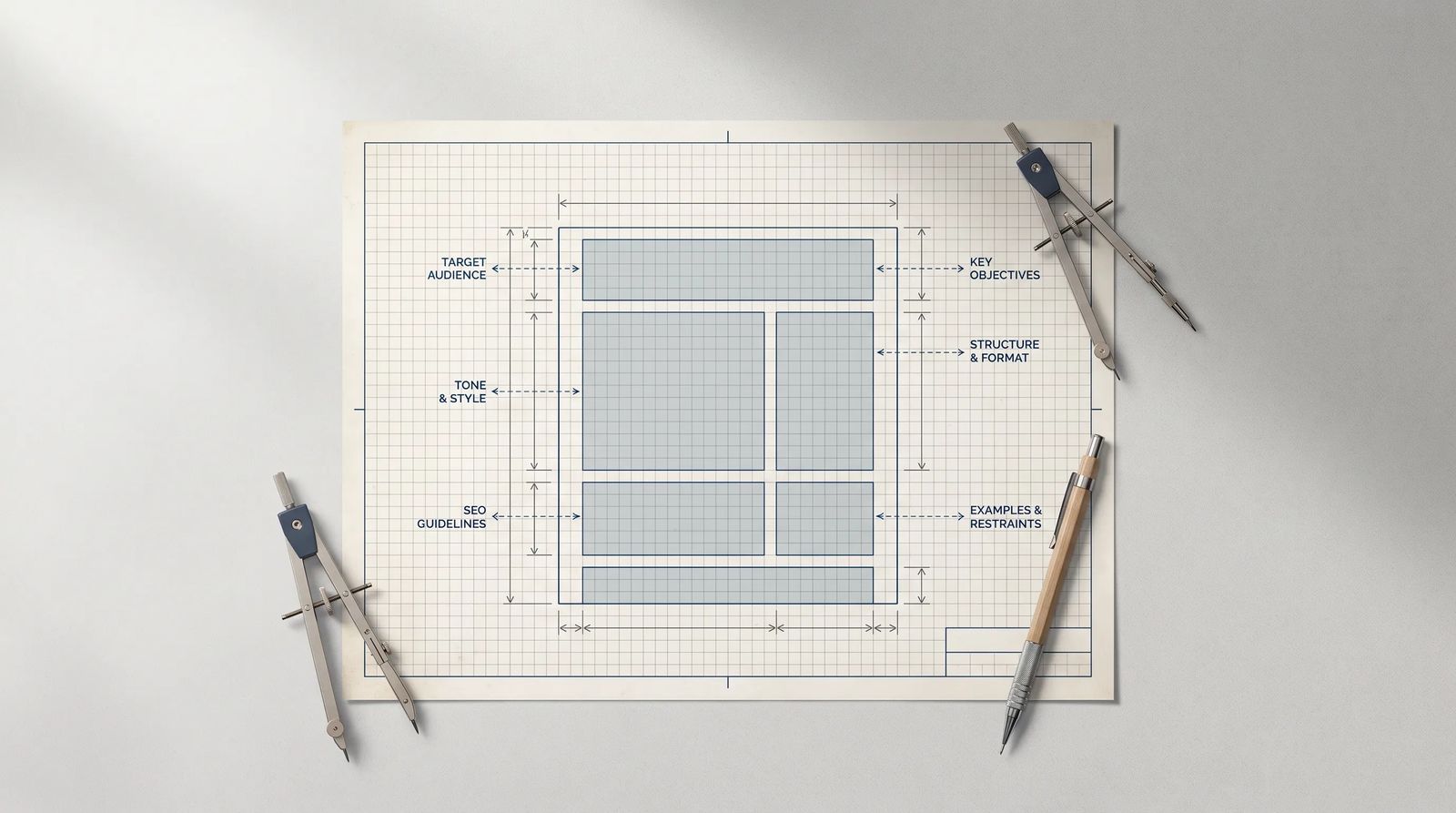
A content brief for an AI writer isn’t a mood board or a set of vibes — it’s closer to a spec sheet. If a claim in it can’t be turned into a yes/no check against the finished draft, it’s not doing its job.
This article shows you how to build that kind of brief section by section, phrase instructions so they’re unambiguous, and run a checklist pass on the output before you publish anything.
What is a content brief?
A content brief is a document that tells a writer — human or AI — what to produce, for whom, and against what standard. It sits between strategy and execution: the keyword research, the audience insight, and the editorial goals have already happened somewhere upstream, and the brief translates that thinking into instructions specific enough to write from.
For a human writer, a content brief can lean on shared context. An experienced writer fills gaps with judgment. An AI writer doesn’t. It doesn’t push back, and it doesn’t sit with ambiguity — it resolves it silently, in whatever direction its training nudges it, and hands you a confident draft built on a guess you never approved. The brief has to remove the guesswork before the draft exists, not correct it afterward.
Content brief vs. creative brief

A creative brief is upstream and directional. It covers brand voice, campaign concept, emotional territory, and the big creative swing. It’s meant to inspire and constrain creative thinking, not specify a single finished asset.
A content brief is downstream and executional. It assumes the creative direction already exists and focuses on one deliverable: this article, this page, this asset. It specifies structure, sources, audience, and deliverable format precisely enough that someone (or something) can sit down and produce the thing without further discussion.
| Creative brief | Content brief | |
|---|---|---|
| Scope | Campaign, brand, or concept | One specific deliverable |
| Output | Direction and inspiration | Instructions to execute |
| Ambiguity | Some is expected — creatives interpret | Ambiguity is a defect to remove |
| Audience | Creative teams, agencies | Writers — including AI writers |
| Checkable? | Loosely, by feel | Requirement by requirement |
For AI execution, this distinction matters more than it does for human teams. An AI writer given a creative brief instead of a content brief will produce something that “feels” roughly right and gets almost every concrete detail wrong — word count, structure, sourcing, scope. Feed it a content brief instead, and there’s very little room left for it to freelance.
What should a content brief include?

A content brief built for AI execution needs to answer six questions, and each one needs to be answerable in a form that can later be checked against the draft.
1. Project overview
State what the piece is, why it exists now, and where it lives. Name the content type (blog post, landing page, comparison guide), the primary keyword or topic, and the URL or slug if one’s already decided. This section should be answerable in a single glance, not inferred from context scattered through the rest of the document.
2. Purpose of the requested asset
Say what this piece needs to accomplish. Not “inform the reader” — that’s true of almost everything. Be specific: is this meant to rank for a keyword and capture top-of-funnel search traffic? Convert a reader who’s already comparing options? Support a sales conversation by giving prospects something to read before a call? Each purpose implies different structural choices, and an AI writer that’s told the purpose explicitly will make those choices correctly instead of guessing.
3. Audience
Vague audience descriptions are one of the most common brief failures. “Small business owners” describes a huge, varied population with wildly different vocabularies, pain points, and buying stages. An AI writer can’t act on that description — it will default to a generic, middle-of-the-road voice that fits everyone poorly.
Instead, define audience along dimensions the AI can actually use while writing:
- Role and context — not “marketers,” but “a solo founder who also runs marketing, with no dedicated content team.”
- Existing knowledge — does the reader already know the basic concept, or does the piece need to establish it from zero?
- The problem that brought them here — what were they searching for, or what question triggered the need for this piece?
- What they’re deciding — are they evaluating options, troubleshooting a problem, or building general understanding with no near-term decision?
A brief that says “written for a busy operator who’s evaluating whether to hire a writer or use an AI tool, has no content background, and needs to make a decision this week” gives the AI writer something to write toward. “Small business owners” does not.
4. Key messaging
This is where you tell the AI writer what the piece needs to argue, claim, or land on — not just what topic it covers. Key messaging usually includes:
- The core takeaway the reader should walk away with, stated as a sentence, not a theme.
- Any points of view the piece should take a clear position on, rather than presenting neutrally.
- Terminology to use consistently, and terminology to avoid.
- Any claims that must NOT be made — if the piece shouldn’t imply a guarantee, promise a specific outcome, or compare against named competitors, say so explicitly. An AI writer won’t know a boundary exists unless you draw it.
Vague key messaging produces a draft that’s topically correct and directionally useless. Specific key messaging gives the AI writer a spine to write around.
5. Deliverables
This section is where “checkable” becomes concrete. Deliverables should specify:
- Format and length — word count range, not “long-form” or “comprehensive.”
- Structure — required headings or sections, and the order they go in, if order matters.
- Required elements — does it need a table, an FAQ section, a comparison, a worked example, a specific number of subheadings?
- Tone and reading level — described in terms an AI can act on (“plain language, minimal jargon, short paragraphs”) rather than adjectives alone (“professional but friendly”).
- What “done” looks like — a one-line definition of a complete, acceptable draft.
Every item here should be something you could literally check against the finished text with a yes or no. “Include a comparison table with at least four rows” is checkable. “Make it thorough” is not.
6. Sources
Tell the AI writer what it’s allowed to draw on and what it isn’t. This is the section most human-oriented briefs skip entirely, and it’s the one that matters most for AI execution.
Specify:
- Any source material the writer should use — internal documentation, past published pieces, specific data you’re supplying.
- Whether the piece should rely on general domain knowledge and reasoning, or whether every substantive claim needs to trace to a supplied source.
- What kinds of claims are off-limits without a source — statistics, named comparisons, pricing, dates, anything that reads as a verified fact rather than a reasoned explanation.
- Whether hypothetical examples are allowed, and if so, that they should be clearly framed as hypothetical rather than presented as things that actually happened.
This section exists because AI writers are fluent enough to make an unsupported claim sound exactly as confident as a supported one. The brief is the only place that boundary gets drawn before the draft exists.
Phrasing instructions so an AI writer can act on them

The gap between a human-readable brief and an AI-executable one is almost always a gap in phrasing, not content.
Replace adjectives with observable behavior. “Write in a conversational tone” is an adjective wrapped around a guess. “Use contractions, second person, and sentences under 20 words on average” is a set of behaviors an AI writer can actually follow and you can actually check.
Replace ranges with numbers where precision matters. “Keep it fairly short” invites wildly different interpretations. “800–1,000 words” doesn’t.
Name the negative space. Don’t just say what to include — say what to exclude. “Don’t compare us to named competitors,” “don’t include pricing,” “don’t imply a guarantee” are instructions an AI writer will follow precisely, but only if you state them. Silence on a boundary reads as permission.
Give structure as a list, not a paragraph. “The piece should cover the problem, then the solution, then some examples, and wrap up with a summary” is a paragraph an AI has to parse into structure. A numbered list of required headings removes the parsing step entirely.
Anchor abstractions to an example. If you want a certain tone, don’t just describe it — show one sentence of it. “Tone example: ‘This isn’t a nice-to-have. It’s the difference between ranking and not ranking.’” One sentence like that disambiguates tone faster than three adjectives.
A worked before/after example
Before (human-oriented brief):
Write a blog post about content briefs for AI writing tools. Make it comprehensive and helpful for small business owners. Should be SEO-friendly and engaging. Include some examples. Keep it professional but approachable.
An AI writer given only this will guess at length, guess at structure, guess at what “SEO-friendly” requires, and invent examples with no boundary on what those examples can claim.
After (AI-executable brief):
Overview: Blog post, primary keyword “content brief,” 1,700–1,900 words.
Purpose: Rank for informational search intent from operators researching how to brief AI writing tools; the reader should leave knowing exactly what sections a brief needs.
Audience: A founder or solo operator with no content team, already using or considering an AI writer, moderately familiar with SEO terms but not with editorial process. They are deciding how to structure their next brief today, not researching the concept abstractly.
Key messaging: The core takeaway is “specificity and checkability, not length, make a brief AI-executable.” Take a clear position that vague adjectives (e.g., “engaging,” “comprehensive”) are brief defects, not style choices. Do not claim any specific AI tool will guarantee better rankings.
Deliverables: H2s for each of the six brief sections in order. One comparison table (qualitative, no invented numbers). One worked before/after example. Reading level: professional, plain vocabulary, short paragraphs, second person for the reader.
Sources: Rely on general knowledge of editorial process and SEO concepts. No statistics, named studies, or version-specific claims. Hypothetical examples must be explicitly framed as hypothetical.
Every clause in the second version can be checked against the finished draft. Word count: check. Six H2s in order: check. One table: check. No unsupported statistics: check.
Common failure modes when AI writers execute weak briefs
Scope creep from an underspecified purpose. Tell an AI writer to “cover content briefs” with no purpose statement, and it will try to cover everything adjacent — creative briefs, editorial calendars, style guides — because nothing told it where the edges are.
Invented specifics filling a sourcing gap. If the brief doesn’t restrict sourcing, an AI writer under pressure to sound authoritative will often produce a plausible-sounding statistic or a named comparison that has no basis. This is the single most expensive failure mode, because it’s the hardest to catch on a skim — it reads exactly as confident as a true claim.
Tone drift from adjective-only instructions. “Professional but friendly” gets interpreted differently every run. Behavioral phrasing — sentence length, person, contraction use — collapses that variance.
Structural mismatch from paragraph-form instructions. When required structure is buried in prose instead of listed, AI writers frequently miss a required section entirely.
No definition of “done.” Without an explicit deliverable checklist, there’s no way to know whether a draft satisfies the brief or just resembles it. This makes revision cycles expensive — you’re re-negotiating the spec after the fact instead of checking against one.
How to make it easier to write content briefs
Build a standing template with the six sections as fixed headers, and pre-fill the parts that don’t change per piece: your standard audience definition, your standard sourcing rules, your standard tone anchor sentence. Leave blank only the fields that genuinely vary — topic, purpose, specific deliverables, specific messaging. This turns brief-writing from a blank-page exercise into a fill-in-the-blanks one.
Run a short pre-flight check before handing the brief off: does every adjective have a behavioral equivalent? Does every requirement convert into a yes/no question? Are the sourcing boundaries stated, not implied? If a section only makes sense to someone who already has context, rewrite it.
Key takeaways
- A content brief for an AI writer needs to be checkable, not just readable — every instruction should convert into a pass/fail question against the finished draft.
- Distinguish content briefs from creative briefs: creative briefs set direction and tolerate interpretation; content briefs specify one deliverable precisely enough to execute without discussion.
- The six load-bearing sections are overview, purpose, audience, key messaging, deliverables, and sources — and sources is the section most briefs skip, to their cost.
- Replace adjectives with observable behavior, ranges with numbers, and paragraph-form structure with lists.
- State sourcing boundaries explicitly. An AI writer will fill an unmarked gap with something that sounds confident whether or not it’s true.
- Build a reusable brief template so consistency doesn’t depend on remembering every rule each time you write one.
FAQ
How long should a content brief be? Long enough to answer all six sections specifically, short enough that nothing in it is vague filler. A tightly written one-page brief with concrete deliverables usually outperforms a five-page brief full of adjectives.
Can I reuse the same brief template across different topics? Yes — that’s the point. Keep audience definitions, sourcing rules, and tone anchors standardized in the template, and only change topic, purpose, and specific deliverables per piece.
What’s the single highest-impact section to get right? Sources. It’s the section most likely to be missing entirely, and its absence is what lets an AI writer invent statistics or claims that sound verified but aren’t.
Do I need a creative brief before I write a content brief? Not always. If your voice, positioning, and audience are already settled, you can go straight to a content brief for each individual piece. A creative brief matters more when you’re establishing new direction — a rebrand, a new campaign, a new product line — that hasn’t been defined yet.
How do I check a draft against the brief once it’s written? Go requirement by requirement, not impression by impression. Pull each deliverable and messaging line from the brief and ask a yes/no question of the draft: is the word count in range, is each required heading present, are the sources cited or acknowledged, does any claim exceed the sourcing boundary you set?